
When Russia Wants a Bioweapon,
it... gets one

UPDATE: This piece has been finalized and published separately below as one part in a long essay series on AI biorisk.

Analysis of Historical Case Studies - Part 2: Government-Sponsored Programs
This piece is more analytical/formal in tone than what I usually publish on Substack; it’s part of a longer policymaker-facing essay on AI biosecurity risks, and it focuses on government-sponsored programs of the past and present. Consider yourself warned.
Part 1 on rogue actors can be read here.
I. Historical Precedent
Governments have repeatedly demonstrated both capability and willingness to develop and deploy bioweapons.
A. Soviet Biopreparat Program
In 1972, the Soviet Union signed the Biological and Toxic Weapons Convention, pledging not to develop, produce, or stockpile bioweapons. A year later, the Soviet Union violated the BTWC by creating Biopreparat, a massive biological warfare enterprise masquerading as a civilian pharmaceutical company.
Through the program, Soviet scientists reportedly manufactured an estimated 20 tons of plague, 20 tons of smallpox, and hundreds of tons of anthrax; they also weaponized tularemia, epidemic typhus, Q fever, and Marburg virus, while studying the potential use of Ebola and encephalitis.
The program’s exact scale remains disputed. The Federation of American Scientists states the following:
“At its peak, the former Soviet Union had the world's largest biological warfare program, with somewhere between 25,000 and 32,000 people employed in a network of 20 to 30 military and civilian laboratories and research institutions. An additional 10,000 or so worked in Defense Ministry bioweapons laboratories. According to other estimates, at least 47 labs and test facilities were scattered across Russia, employing more than 40,000 workers, 9,000 of whom were scientists. Between 1,000 to 2,000 of those scientists were experts on deadly pathogens.”
Meanwhile, Congressional testimony asserts:
“The size and scope of this program were enormous. For example, in the late 1980s and early 1990s, over 60,000 people were involved in the research, development, and production of biological weapons.”
—Dr. Kenneth Alibek, before the Joint Economic Committee, United States Congress
Regardless of the precise number, Biopreparat was unquestionably the largest biological warfare program in history.
Even decades after its official end, the program’s deadly legacy endures. Contaminated testing sites like Vozrozhdeniya Island still harbor active anthrax spores buried in the soil since the Soviet era:
“Vozrozhdeniya was once home to a vibrant fishing village fringed by turquoise lagoons, back when the Aral Sea was the fourth-largest in the world and abundant with fish…
Over the years the site flourished into a living nightmare, where anthrax, smallpox and the plague hung in great clouds over the land, and exotic diseases such as tularemia, brucellosis, and typhus rained down and seeped into the sandy soil.”
—BBC, “The deadly germ warfare island abandoned by the Soviets”
The true nature of the program only became clear after the Soviet collapse in the 1990s.
B. Imperial Japan’s Unit 731
Before the Soviet Union developed Biopreparat, Imperial Japan’s Unit 731 demonstrated that biological weapons could work on a massive scale. Active from 1936 to 1945, Unit 731 is notorious for its systematic human experimentation and operational deployment of biological weapons against Chinese civilians.
Unit 731 researchers reportedly used “political prisoners, criminals, the poor, and homeless” in their tests; test subjects also “included women and children.”
Unit 731 wasn’t the only bioweapons development program to conduct experiments on humans, but it was the only one to systematically integrate mass human experimentation with active biological warfare. Researchers used thousands of human subjects to perfect biological weapons that were immediately deployed against civilian populations. An estimated 3,000 died in horrific experiments, while tens of thousands more were killed by the weapons those experiments helped develop:
“Elderly plaintiffs flew from China to testify - often in tears - about their communities being ravaged by diseases that spread mysteriously after Japanese planes flew low overhead and dropped wheat, rice or cotton infested with fleas…”
[Trigger Warning: Graphic]
“Researchers performed surgeries and vivisections on their victims without the use of anesthesia, removing organs and severing limbs… [s]ome victims had their limbs amputated and reattached to other parts of their body; others were subjected to extreme cold to gauge the effects of frostbite and gangrene on human skin. Many were exposed to poison gas or deadly diseases to observe the amount of time it took a person to show the effects or symptoms before dying… doctors subjected victims to starvation, dehydration, extreme air pressure, or electrical current to see how long a human could survive under such conditions… estimates ranging from thirty thousand to more than five hundred thousand are believed to have died in field tests of diseases on the Chinese population.”
According to EBSCO, Unit 731 also focused on creating weaponized deployment options: they developed a bomb of plague-infested fleas, and planned to deploy their weapons using balloons sent “adrift across the Pacific” or through aircraft-delivered plague bombs on U.S. cities.
The war ended before those plans were executed; as evidenced by Biopreparat, what the program had demonstrated about the feasibility of mass-casualty biological warfare did not end with it.
II. Contemporary Cases
If the Biopreparat and Unit 731 established that states will build these weapons when they see a use for them, the question for the present is who is still doing so. The U.S. government’s answer names four states:
A. Russia
Russia is the direct heir to the largest bioweapons program in history, and the U.S. government does not believe the inheritance was ever fully renounced. According to a State Department report released in 2025, U.S. intelligence believes that the Soviet program was absorbed rather than dismantled by the Russian Federation, and that Russia currently “maintains an offensive biological warfare program.”
In the wake of Russia’s invasion of Ukraine, the program appears to be expanding. In October 2024, the Washington Post reported on satellite imagery of Sergiev Posad-6, a military site northeast of Moscow with a Cold War history of weaponizing smallpox and Ebola:
“A few months after Russia began its full-scale invasion of Ukraine in 2022, satellite imagery captured unusual activity at a restricted military research facility… construction vehicles renovating the old Soviet-era laboratory and breaking ground on 10 new buildings, totaling more than 250,000 square feet, with several of them bearing hallmarks of biological labs designed to handle extremely dangerous pathogens.”
—Washington Post, “Satellite images show major expansion at Russian site with secret bioweapons past”
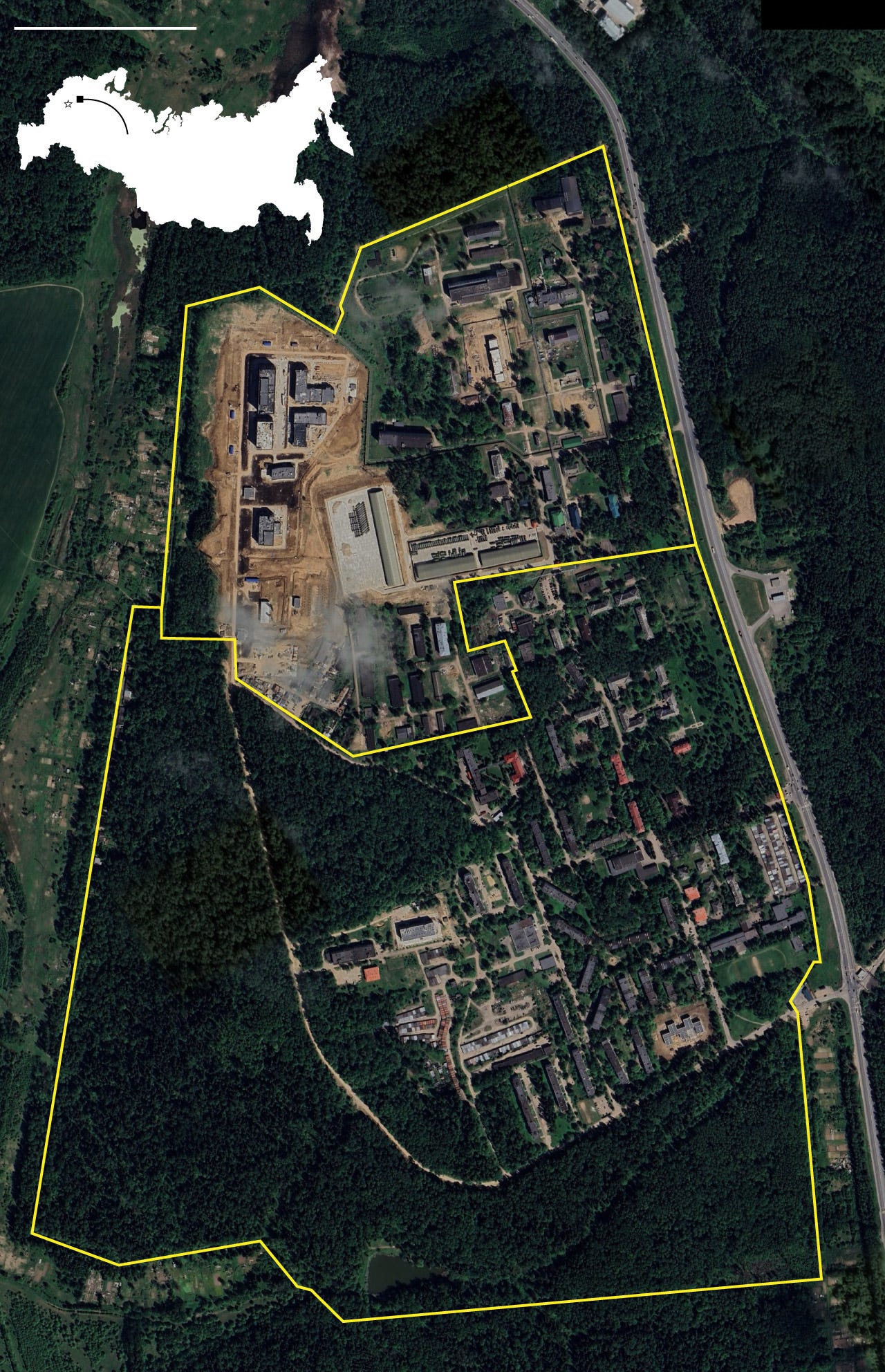
Russian officials have framed the expansion as biodefense. It’s impossible to discern from satellite photos alone what the true nature of the facilities is.
B. China
The U.S. government states that China possessed its own biological weapons program from “the 1950s to at least the late 1980s.” As part of the program, the country is said to have “weaponized ricin, botulinum toxins, and the causative agents of anthrax, cholera, plague, and tularemia.”
What’s unresolved is whether ‘at least the late 1980s’ was actually the end. The State Department does not assert the program continued, but it does not rule out the possibility: China has never disclosed its historical facilities in any BWC submission, and the same report flags continuing biotech research by Chinese military medical institutes that could have weapons uses. This year, there’s also a new concern:
“For the first time, this year’s report warns that China probably is capable of using publicly available artificial intelligence and machine learning (AI/ML) tools to advance efforts related to biological weapons applications. At the same time, China ‘probably is unable to make complex scientific equipment without Western innovation.’”
—Council on Strategic Risks, “The State of Compliance with WMD-Related Treaties”
Notably, the AI dimension flagged here is not unique to China; it runs through every contemporary case, and it’s the subject of the analysis to come.1
C. North Korea

While China is assessed as a “compliance concern,” the State Department states the case for North Korea plainly: the U.S. assesses that the DPRK has a dedicated, national-level offensive biological weapons program, and possesses the technical capability to produce pathogens and toxins usable as bioweapons, and to engineer them genetically.
“The United States assesses that the DPRK has a dedicated, national-level offensive [biological weapons] program… Pyongyang probably is capable of weaponizing BW agents with unconventional systems such as sprayers and poison pen injection devices, which have been deployed by the DPRK for delivery of chemical weapons and could be used to covertly deliver BW agents.”
While the State Department’s paper does not dive into the specifics of the DPRK’s program, South Korean defense analysts believe that “B. anthracis, Variola virus, Yersinia pestis, Vibrio cholerae, and botulinum toxin” are the most likely candidates for weaponization.
“These same agents are classified as top-tier biological threats by both the U. S. Centers for Disease Control and Prevention (CDC) and WHO.”
—Jungeun Lee, Korea Research Institute for Defense Technology Planning and Advancement
Concerningly, the June 2024 Treaty on Comprehensive Strategic Partnership between Russia and North Korea establishes plainly that the two states will “actively encourage joint research in the field of science and technology, including such areas as space, biology, peaceful nuclear energy, artificial intelligence, [and] information technology.”
D. Iran
Russia and North Korea have confirmed offensive programs, and there’s a verified historical program with unanswered questions about the extent to which it continues in China. Meanwhile, Iran’s case is interesting because it centers on the dual-use problem: the U.S. says nothing about a confirmed program; the country only alleges an intention. The U.S. says that “Iran has not abandoned its intention to conduct research and development of biological agents and toxins for offensive purposes,” and that it has facilities that possess the capability to produce bioweapons, if directed:
“Iran maintains flexibility to use, upon leadership demand, legitimate research underway for biodefense and public health purposes for a capability to produce lethal BW agents. It is unknown if Iran’s leadership has set a directive to maintain this flexibility.”
III. Analysis

A clear conclusion that can be drawn from the above is that states succeed where others fail because they have substantially more resources than typical rogue actors. Biopreparat was composed of tens of thousands of experts, and states can draw from large military budgets to finance their operations. That’s true, but the more interesting read is that state resources reliably buy capability. Biopreparat and Unit 731 were successfully able to synthesize deadly bioweapons, and Russia, China, and North Korea all appear to possess some capability to produce bioweapons, with Iran assessed as able to develop it on demand. But capability is not the same as use: of every program in this essay, only Unit 731 ever achieved mass-casualty deployment.
Most of the time, even states that solved the resource and expertise problems mostly declined to use what they built. Why is that? The reason for this appears to be that biological weapons have rarely offered enough strategic utility to justify the risks of using them on a battlefield, in a conflict between two states.
Countries have specific incentives: they want to protect their own troops during war time. Blowback risks, along with the threat of nuclear retaliation in some cases (the UK, for example, reserves the right to deploy nuclear weapons if chemical or biological weapons are deployed against its people), complicate this goal. They are further bounded from bioweapons use by a near-universal international norm.
Ultimately, the fact that states also have a wide variety of conventional weapons in their arsenals make it difficult to justify deploying bioweaponry.
However, the degree to which this constraint is binding depends upon a rational state actor weighing controllable outcomes. In recent history, the limiting factor has never solely been the technical challenge of developing these weapons: instead, it has primarily been the fact that those with the capability to build them often did not consider their use worthwhile. This restraint appears to be a property of who holds the capability, not of the weapons themselves– and as evidenced by Unit 731, even that hasn’t been a fully successful restraint in the past.
The relevant question for the present is what happens when that capability becomes available to actors whose calculations are different: namely, actors who are not deterred by blowback, not bounded by international norms, unafraid of state-level deterrence, and not optimizing for controllable outcomes.
Part 3 of this series will be on how AI and existing technologies are changing the bio-threat landscape.
In a later section of this essay, which will be published soon.
interesting stuffs!