
Turns Out, You Can’t Just Bomb a Datacenter
Notes on kinetic MAIM & escalation constraints


Once upon a time, I did a bit of writing about MAIM:
How MAIM may not be a good deal for America
Would recommend reading this piece for a brief intro to the argument for how MAIM works, if you’re unfamiliar.
And, in my last post about MAIM, I unwisely promised:
In Part 3, I’ll examine how attribution ambiguity, proxy operations, and escalation risks shape retaliation calculations.
Alas! It has been quite a while since I’ve published anything about MAIM, having taken various detours to write about AIxBiosecurity, data poisoning, and most recently, the AI safety funding landscape. But I promised more follow-up work, and I intend to keep that promise!
So, in the remainder of this post, I’ll be attempting to explore the following questions:
What options do both sides (China and the U.S.) have for kinetic strikes on each others’ datacenters?
How escalatory are those options?
Forgive me, I’m saving analysis of attribution ambiguity and proxy operations for another day.
Can China Bomb a U.S. Datacenter?
“Footnote 3: China’s long-range missile capabilities (DF-41 and DF-5B systems) seemingly do not allow them to launch strikes that the US would know are non-nuclear. This might make China especially reluctant to use this option because a conventional strike might be misinterpreted as nuclear, raising the likelihood of escalation.”
—Oscar Delaney, Crucial Considerations in ASI Deterrence
What weapons systems does China have that are capable of reaching the U.S.?
Nuclear ICBMs (land-based)
There are two main types of land-based ICBMs in the Chinese arsenal: mobile missiles carried on trucks (the DF-41 and DF-31) and older missiles primarily housed in fixed underground silos (the DF-5B/C). Both can reach the continental U.S. While the mobile ones are harder to find and destroy, the silo-based DF-5 carries a heavier payload, and China’s silo fields are growing.
Nuclear SLBMs (sea-based)
China is arming its Type 094 submarines with the JL-3. Whether this lets them reach the continental U.S. is contested: the Pentagon expects the subs to be able to threaten the U.S. mainland from protected coastal waters like the South China Sea, while other analysts assert that “Chinese SSBNs cannot target continental United States from their operating areas.”
Conventional ICBM: This is where things get non-nuclear, and interesting! The new DF-27 is a solid-fueled missile likely carrying a hypersonic glide vehicle and with an estimated 5,000–8,000 km range, meaning it can reach Alaska, Hawaii, and parts of the continental United States. For more, see below:
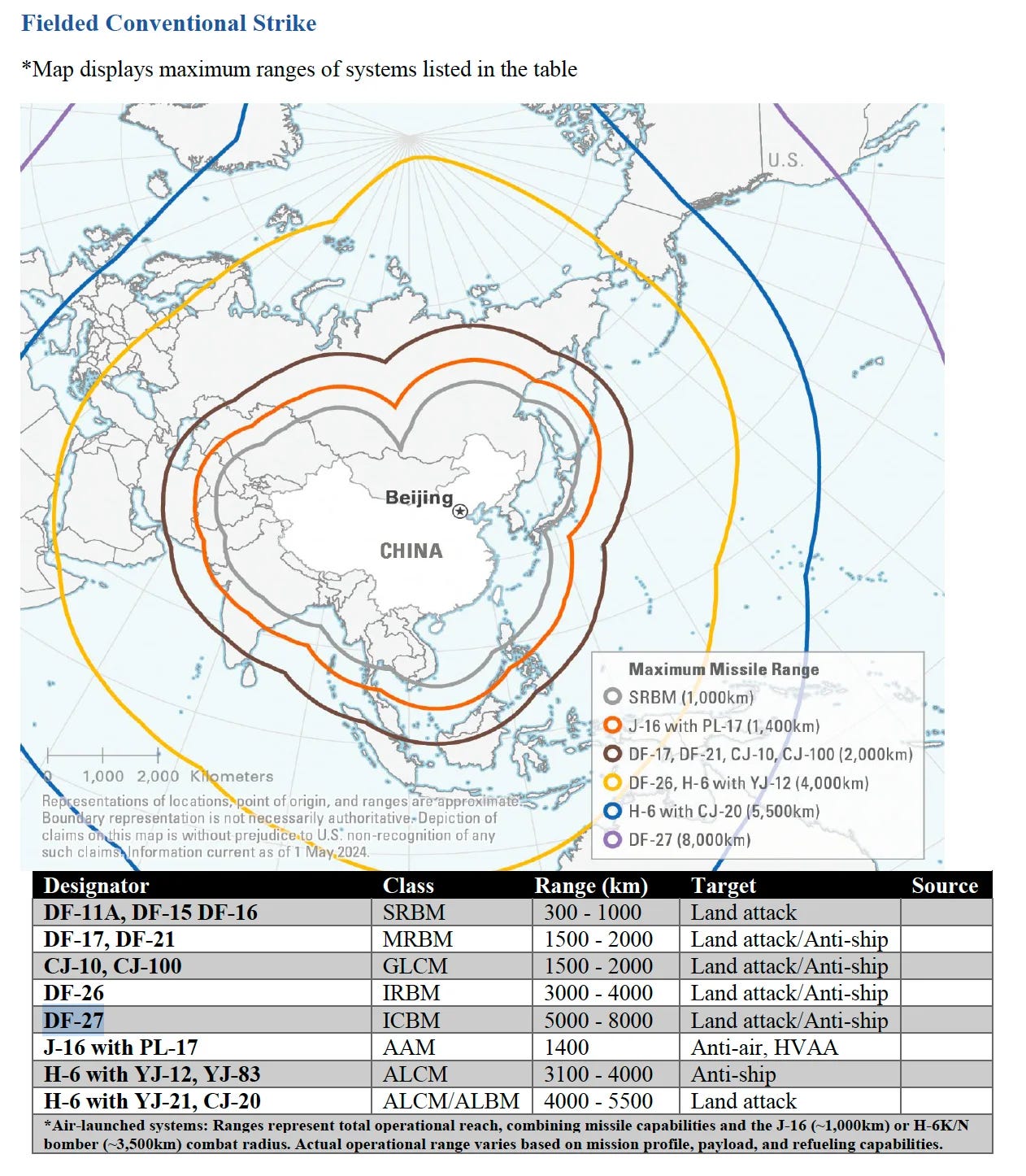
“Among the 2025 Pentagon report’s greatest revelations, the People’s Republic of China (PRC) has fielded a conventional intercontinental ballistic missile (ICBM) able to range parts of America’s homeland. This makes China the first nation publicly assessed to have fielded an operational, conventionally-armed ICBM…”
—Dr. Andrew S. Erickson, Professor of Strategy in the U.S. Naval War College (NWC)’s China Maritime Studies Institute (CMSI)
(Note: Certain newer systems such as the DF-61, unveiled in 2025, are omitted from the above; too little is publicly known to characterize them.)
Can the U.S. Bomb a Chinese datacenter?
Before we get to why this matters, the same question in reverse:
What weapons systems does the U.S. have that are capable of reaching China?
Nuclear ICBMs and SLBMs
Like China, the U.S. fields silo-based ICBMs (the Minuteman III, now being replaced by the Sentinel) and submarine-launched ballistic missiles (the Trident II D5 on Ohio-class subs). Both can reach China.
A bomber force and conventional, non-ballistic reach
Unlike China, the U.S. has a mature bomber force and a substantial number of conventional, non-ballistic weapons for reaching Chinese targets, including precision munitions and long-range cruise missiles fired from aircraft, ships, and submarines.
Writing in 2015, Hans Kristensen, Director of the Nuclear Information Project at the Federation of American Scientists, argued that:
“[A]dvanced conventional cruise missiles can now serve the role that nuclear air-launched cruise missiles used to serve: hold at risk heavily defended strategic and tactical targets at a range far beyond the reach of modern and anticipated air-defense systems. The Navy already has its Tactical Tomahawk widely deployed on ships and submarines, and now the Air Force is following with deployment of thousands of long-range Joint Air-to-Surface Standoff Missiles (JASSM-ER) on bombers and fighter-bombers.”
The U.S. military’s conventional long-range weapon options have only increased since.
The Asymmetry
Each side has weapons that can reach the other’s homeland, but they differ in one decisive respect: how. Because they are all rocket-boosted, every system China can use to reach the U.S. homeland is, at least for early-warning systems, indistinguishable from a nuclear strike. Even a purely conventional strike with the DF-27 couldn’t be confidently distinguished from a nuclear launch in the warning window; it would register on the same nuclear early-warning systems, and force the same time-pressured decision.
The U.S. can instead reach Chinese targets with non-ballistic, recognizably conventional delivery methods– i.e., bombers and cruise missiles– that don’t trip the same nuclear early-warning reflex.
So China has no way to conventionally strike the U.S. homeland that doesn’t carry clear nuclear-escalation risk, while the U.S. has options that are at least less ambiguous.
Analysis
As it stands, China can’t kinetically MAIM the U.S. without incurring serious risk of nuclear retaliation. It’s worth noting that the Chinese military’s currently-under-development H-20 stealth bomber could undermine this by giving China a non-ballistic, non-hypersonic option for a U.S. strike; however, it appears to lag far behind U.S. bombers, with intelligence assessments calling it unlikely to debut until the 2030s.
On paper, the U.S. might be able to pull off a kinetic strike without triggering nuclear early warning systems, because they have an array of conventional weapons that can reach China. Yet, I still think it’s highly unlikely. Why? U.S. standoff missiles fired from outside China’s air defenses can reach coastal and near-inland targets, but striking the interior would generally require stealth bombers or forward basing to penetrate those defenses. This matters because China is increasingly building its largest compute clusters deep inland under its “East Data West Computing” plan, and distributing compute across many sites, making any single strike on a datacenter both harder to reach and less decisive.
Conclusion
Kinetic strikes are often dismissed as sitting comfortably outside the Overton window for either government, but Hendrycks and Khoja (2025) argue in follow-up work to Superintelligence Strategy that “[n]orms will adapt to strategic realities.” Ultimately, doing this research was enough to mostly eliminate kinetic strikes from my mental model of MAIM, even in a world where “it will not be difficult for states to diplomatically and domestically justify their efforts to disrupt another state’s unilateral efforts to attain [powerful AI].”
That leaves the sub-kinetic levers (cyber ops, supply-chain interference, maybe EMPs, other softer forms of sabotage) as the only place a usable MAIM option plausibly survives.
aww maan *disappointed*
Something interesting is that the only difference between ICBMs/hypersonics and "conventional ICBMs/hypersonics" is that the second has enough precision such that a conventional warhead will still cause damage, that's why they're more recent.